GLOW Peptide Stack 70mg Research Blend Vial
GLOW Peptide Stack 70mg Research Blend Vial
Couldn't load pickup availability
Three Research Peptides Working Together
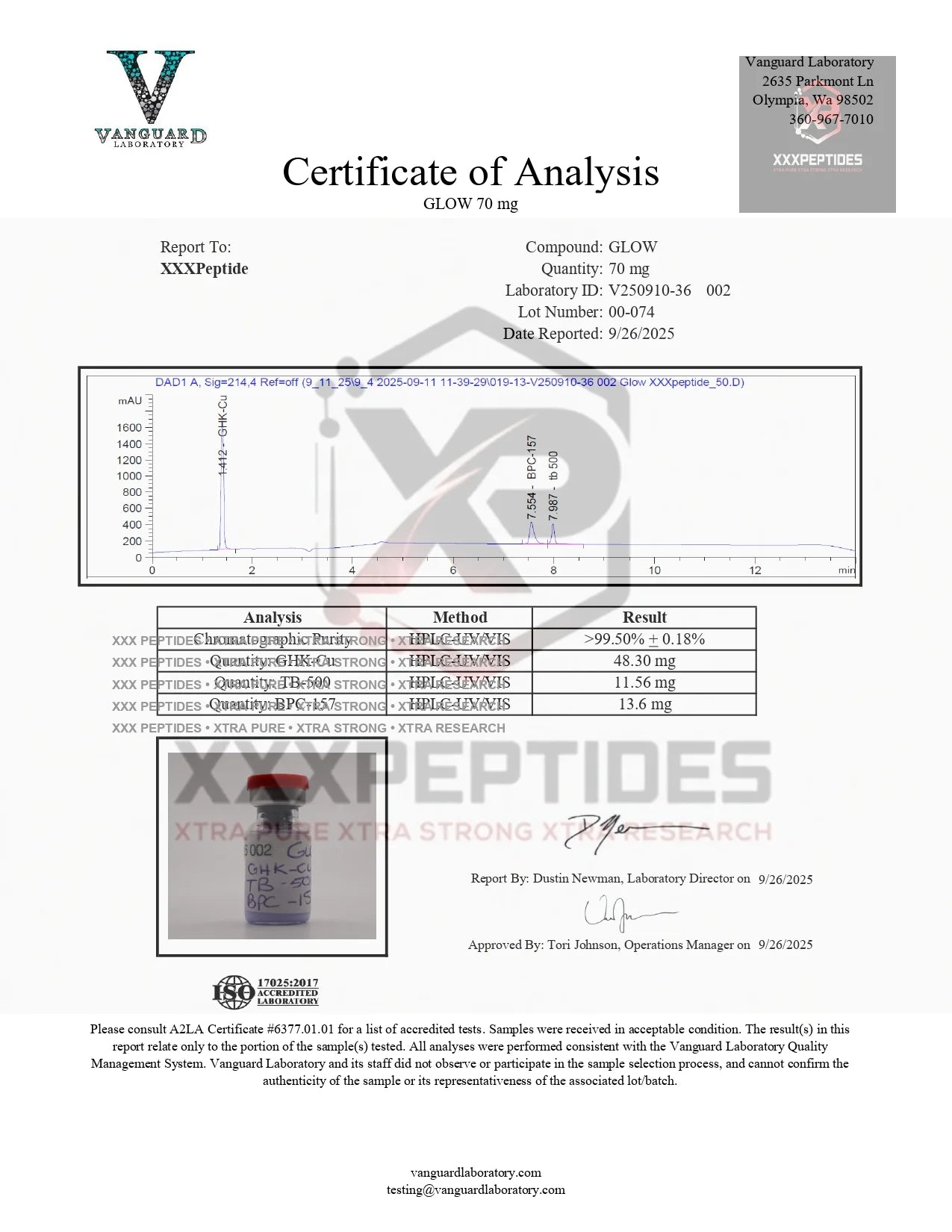
GLOW isn't one peptide. It's three peptides in one blend. GHK Cu, BPC 157, and TB 500 each bring their own shape and their own research history.
GHK Cu comes first. It's a small tripeptide. Three amino acids: glycine, histidine, lysine. A copper ion sits attached to it. Labs study how this peptide and copper interact. They also study how it affects signals in the extracellular matrix. Some teams use it in gene expression models too.
BPC 157 comes next. It's made of fifteen amino acids. It came from gastric research roots. Labs use it to study blood vessel growth patterns. They also study cell protection signals and how cells move during research trials.
TB 500 finishes the stack. It's a lab made version of Thymosin Beta 4. It binds to actin inside cells. Researchers use it to study how cells organize their internal skeleton. It also helps in research on cell differentiation and tissue signaling.
GLOW mixes three different molecules. So it has no single molecular weight. No single formula either. Each peptide keeps its own shape inside the blend. That's the whole point of it. Labs want to see how these three act together, not alone.
Common research uses include matrix regulation, signal cascade studies, peptide synergy models, blood vessel research, and cell skeleton studies. None of this means medical use. Everything stays inside lab settings only.
One thing must stay clear. GLOW is not for humans. It's not for animals either. It's sold only for lab research. The FDA has not approved it to treat or prevent any disease. Nothing here counts as medical advice.
Labs already testing blends like Retatrutide and Cagrilintide may want to compare results with GLOW. It helps show the difference between single target and multi peptide signaling.