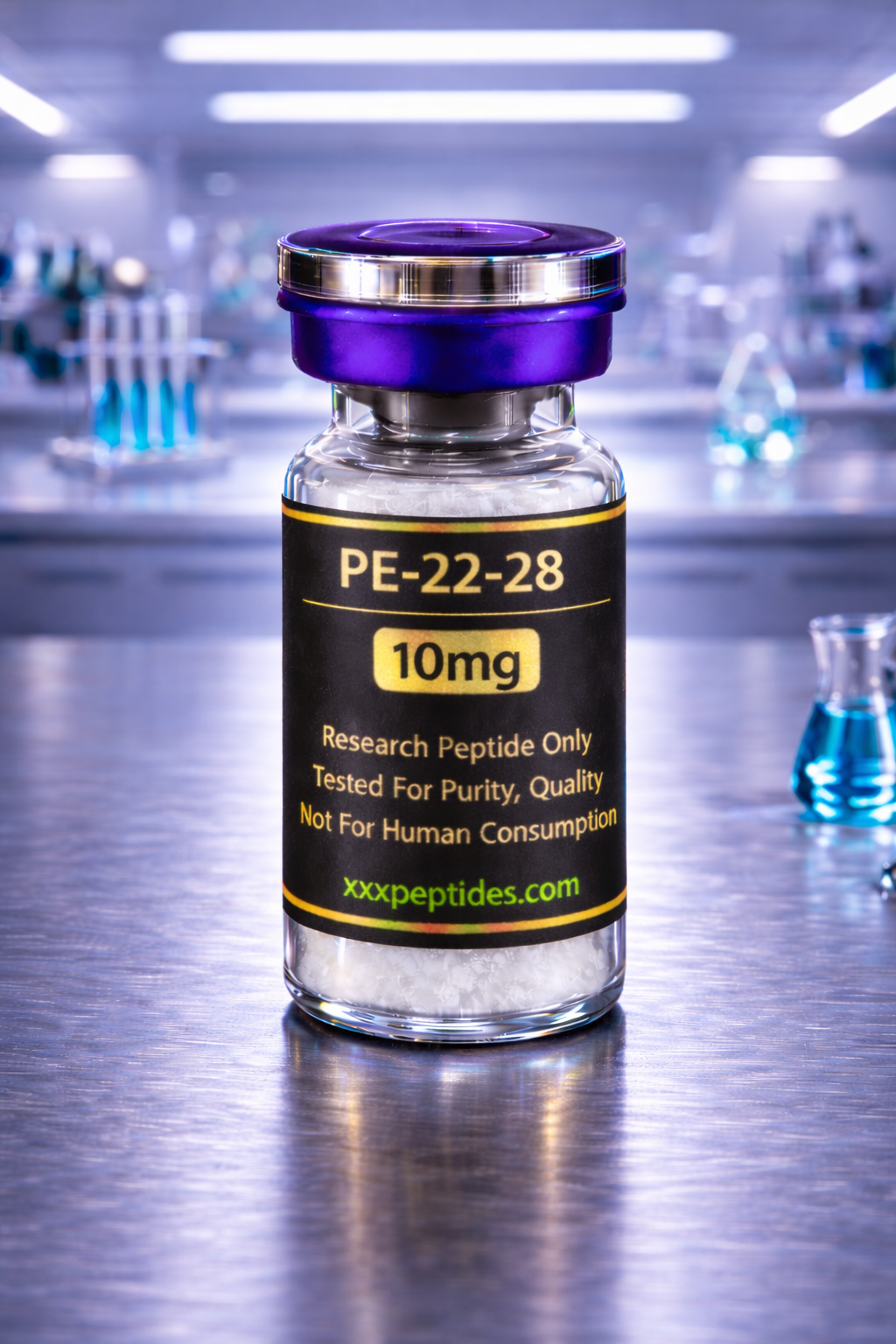
PE-22-38 Mini-Spadin Synthetic Heptapeptide Research Compound Lab Use Only
PE-22-38 Mini-Spadin Synthetic Heptapeptide Research Compound Lab Use Only
Couldn't load pickup availability
Mini-Spadin Heptapeptide Research Compound | Lab Use Only
Seven amino acids. Derived from spadin. That's PE-22-28.
PE-22-28 is also called Mini-Spadin. It's a synthetic heptapeptide — seven amino acids, sequence GVSWGLR. In research literature it gets classified as a selective TREK-1 channel inhibitor. TREK-1 is a two-pore domain potassium channel, also written as K2P2.1. That's the specific receptor target researchers focus on with this compound.
Where does it come from? PE-22-28 is a truncated fragment of spadin. Spadin itself comes from sortilin, a pro-peptide. Researchers took that endogenous sequence and synthesized a shorter version. Seven amino acids instead of the full spadin length. The goal in lab work is understanding what that short fragment does to TREK-1 channel behavior in neuronal signaling models.
Lab only. Not for humans. Not for animals. Period.
Scientific Classification
Common name: PE-22-28
Alternate name: Mini-Spadin
Type: Synthetic heptapeptide (oligopeptide)
Research classification: Selective TREK-1 (K2P2.1) channel inhibitor
Biological origin: Fragment from endogenous spadin, sortilin pro-peptide derivative
Chemical and Structural Information
Amino acid sequence: Gly-Val-Ser-Trp-Gly-Leu-Arg (GVSWGLR)
Molecular weight (free form): ~773.9 Da
Molecular weight (acetate form): ~802.94 Da (varies by salt form)
IUPAC name: (2S)-2-[[(2S)-2-[[2-[[(2S)-2-[[(2S)-2-[[(2S)-2-[[(2S)-2-[(2-aminoacetyl)amino]-3-methylbutanoyl]amino]-3-hydroxypropanoyl]amino]-3-(1H-indol-3-yl)propanoyl]amino]acetyl]amino]-4-methylpentanoyl]amino]-5-(diaminomethylideneamino)pentanoic acid
Research Applications
TREK-1 potassium channel inhibition is the core focus. Two-pore domain K2P channel research uses it regularly. Ion channel modulation work is another area. Neuronal excitability pathway analysis comes up too. SAR studies of spadin-derived peptides also reference PE-22-28 — researchers compare how the truncated fragment behaves versus full-length spadin to understand what parts of the sequence matter most for channel selectivity.
All lab use. All preclinical. No medical claims. Simple as that.
Related Products
Researchers working on other reconstitution or peptide research may also find our Bacteriostatic Water 10ml benzyl alcohol reconstitution solution useful for lyophilized peptide preparation.
Product Details
Category: Synthetic research peptide
Form: Research-grade raw material (see label for prep details)
Quantity: 10mg
Use: Laboratory and developmental research only
Regulatory and Legal
Not FDA approved. Cannot diagnose, treat, cure, or prevent anything. Sold for lab research only. Period.
Not a supplement. Not a drug. Read the terms before ordering. Buying means you are qualified to handle lab materials and you accept full responsibility for safe use.
Safety Information
Keep away from kids. Lab training and proper equipment required. Limited safety data exists outside controlled research settings. Do not consume it. Mishandling may cause harm.