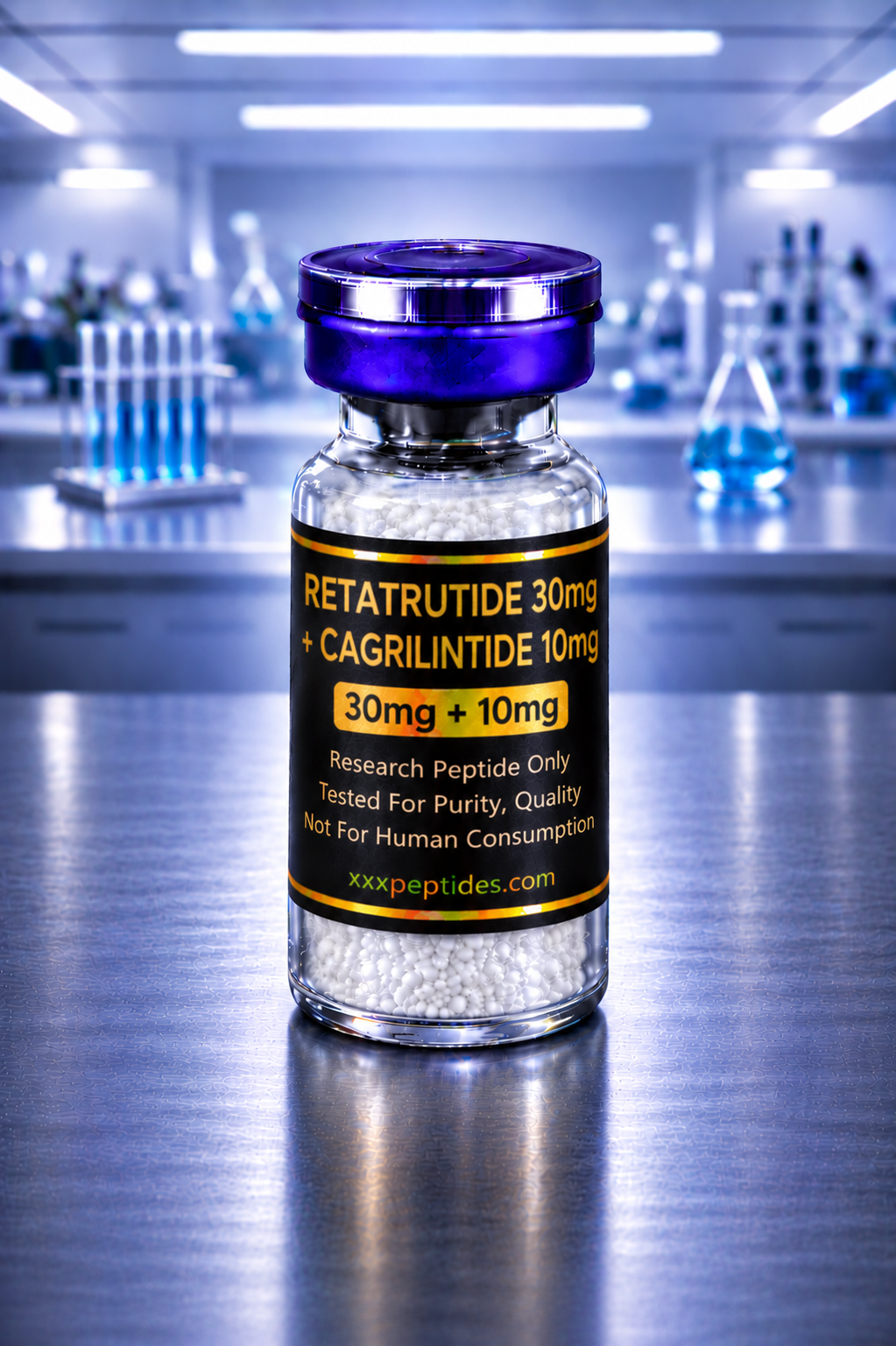
Retatrutide + Cagrilintide Blend Research Peptide Vial
Retatrutide + Cagrilintide Blend Research Peptide Vial
Couldn't load pickup availability
Retatrutide and Cagrilintide: Two Peptides Worth Watching
Lab teams keep talking about two names lately. Retatrutide and Cagrilintide. Both show up in metabolic studies. Both bring something different to the table.
Retatrutide hits three receptors at once. GLP-1, GIP, and glucagon receptors all respond to it in lab models. That's rare. Most peptides hit just one target. This one hits three. Researchers studying multi receptor signaling reach for it because of that range. There's a fatty diacid tag attached to its structure. That tag stretches out its half life in research systems, so it holds up longer during long trials. It weighs around 4731 daltons. Once lyophilized, it turns into a white to off white powder.
Cagrilintide works differently. It mimics amylin, a hormone found naturally in humans, but with some changes. Three proline swaps, at spots 25, 28, and 29, make it more stable. Those swaps also cut down fibril formation, something that's a real problem with unmodified amylin in labs. Scientists use Cagrilintide to study amylin and calcitonin receptors together. Some papers call it AM833. Its weight sits near 4409 daltons. Same as Retatrutide, it comes as a lyophilized powder.
Put both together and you get a wide net for receptor research. One covers three metabolic receptors. The other covers two more. Together, they open up signaling pathways that single target peptides just can't reach.
Quick note. These compounds are strictly for lab and developmental research. No human use. No animal use. No exceptions. FDA hasn't evaluated either one for treating or preventing disease. Nothing here is medical advice.
Teams already working with stability focused peptides like Vilon might find value pairing studies with Retatrutide and Cagrilintide, filling out a fuller picture of receptor behavior in research models.